Functions and consequences of artificial intelligence
in the science and higher education organization
KIWIT is an interdisciplinary and inter-university research network.
Funded by the Federal Ministry for Research, Technology and Space (BMFTR).


About Artificial Intelligence
On the Way to Thinking Machines? Knowledge Evolution and Research Fascination
-
AI as an Object of Epistemological and Scientific-Theoretical Reflection
-
A Transformative Technological Genesis: Enthusiasm and Disillusionment
-
The Problematic Construction of a Concept of Machine Intelligence
The history of artificial intelligence (AI) is by no means purely technological. It is simultaneously a dynamic history of knowledge methodologies, research funding, and societal expectations of utility. AI technologies and systems have evolved in multiple phases, characterized by the often-cited “summers” followed by “winters,” i.e., periods of technological stagnation.
Development has been shaped by contemporary technical paradigms, scientific institutions, and diverse project environments that facilitated the realization of specific initiatives. Throughout this process, the problematic nature of defining intelligence technologically has repeatedly emerged. What constitutes intelligence? To what extent can intelligence be attributed to artificial systems?
This page summarizes key informational resources from AI research. It addresses historical trajectories, cultural patterns, the influence of society on AI, and vice versa.
We also invite you to follow our social media channels, where we regularly publish updates and insights from our field. We welcome your engagement through subscriptions, comments, and shares.
Last Updated: 18 October 2025


The UNIVAC of 1951 was the first commercially available computer in the United States. The UNIVAC I gained fame in 1952 when it correctly predicted the outcome of the U.S. presidential election—a result of statistical computation that was widely perceived as “intelligent.” In the public eye, the UNIVAC was temporarily regarded as a sort of “thinking” computer, which contributed to its fascination. It thus became an early catalyst for the societal imagination of artificial intelligence, even though, technically, AI did not yet exist. The computer was used, among other applications, for the census, weather forecasting, and economic data analysis. (Image: Hulton Archive/Getty Images)

At the very beginning: At the legendary Dartmouth Conference in Hanover, New Hampshire, the pioneers of AI research convened from June to August 1956.
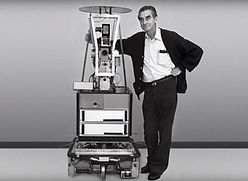
“Shakey the Robot” was one of the first true AI applications in a physical system—a historic milestone in the development of artificial intelligence. The robot is particularly noteworthy because it combined symbolic intelligence with real-world movement (i.e., a physical body), at a time when AI was primarily abstract and software-based. Shakey was developed in 1966 at the Stanford Research Institute. The robot was equipped with a camera for environmental perception, ultrasonic sensors, radio remote control (later partially autonomous), and early AI programs. (Image: Stanford Research Institute)
