Functions and consequences of artificial intelligence
in the science and higher education organization
KIWIT is an interdisciplinary and inter-university research network.
Funded by the Federal Ministry for Research, Technology and Space (BMFTR).


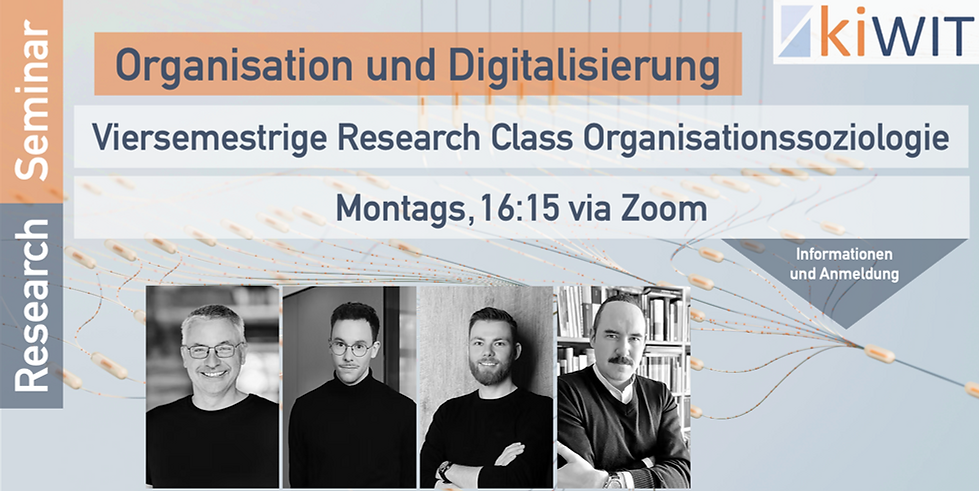
Research class led by Prof. Dr. Stefan Kühl, with staff members Bernd Eckstein and Dennis Düllmann, as well as Prof. Dr. Marcel Schütz.
Offer for researchers and early-career researchers
Digitalization processes in organizations
classify and understand
-
Four-semester course at Bielefeld University
-
Weekly focused text discussions online
-
Regular information on texts and authors is provided on this page
In this research class, designed to run over four semesters, approximately 100 key texts on the topic of organization and digitalization are discussed on a weekly basis. The research class is part of the Bielefeld Graduate School in History and Sociology and is embedded in the KIWIT research group. Due to participation from multiple locations, the seminar is conducted online via Zoom.
For each session, all participants read a selected text, which is then discussed jointly. Prior reading is required for meaningful participation. Attendance is flexible, and participants may join any sessions or discussions that are of interest to them. The research seminar is primarily aimed at doctoral researchers at Bielefeld University and its project partners who are actively engaged in relevant research, but it is also open to interested master’s students and advanced bachelor’s students who have already completed the introductory module in organizational sociology. External researchers from other universities as well as other interested participants with a thematic focus are also welcome. Registration with brief information about one’s background and motivation is required (see information below)
08.06.2026: Tække, J. (2025). Sociological Perspectives on AI, Intelligence and Communication. Systems Research and Behavioral Science, 42(2), 574–584. https://doi.org/10.1002/sres.3123
Gallery | click/swipe

Tække begreift KI als eine eigenständige Form von Intelligenz, die sich grundlegend von der menschlichen Kognition unterscheidet und als computationale Technologie fest in gesellschaftliche Kommunikationsprozesse integriert ist. Bild: KIWIT
Tække begreift KI als eine eigenständige Form von Intelligenz, die sich grundlegend von der menschlichen Kognition unterscheidet und als computationale Technologie fest in gesellschaftliche Kommunikationsprozesse integriert ist. Bild: KIWIT
Gegenstand der nächsten Sitzung ist das Papier von Jesper Tække, das ein umfassendes theoretisches Modell zur Analyse der gesellschaftlichen Herausforderungen durch Künstliche Intelligenz vorlegt. Tække begreift KI als eine eigenständige Form von Intelligenz, die sich grundlegend von der menschlichen Kognition unterscheidet und als computationale Technologie fest in gesellschaftliche Kommunikationsprozesse integriert ist.
Auf Basis von Niklas Luhmanns Systemtheorie untersucht die Arbeit, wie KI über das Konzept einer „virtuellen doppelten Kontingenz“ die Kommunikation auf den Ebenen von Interaktion, Organisation und Funktionssystemen verändert. Am Beispiel des Bildungssystems wird analysiert, wie diese algorithmische Differenzierung traditionelle Kommunikationsstrukturen aufbricht und die funktionale Autonomie etablierter Systeme bedroht. Im Fokus der Sitzung steht Tækkes kritische Diskussion dieser Transformation innerhalb dreier gesellschaftlicher Modelle (autoritär, marktorientiert und demokratisch) sowie die Frage, wie ein europäischer Regulationsrahmen beschaffen sein muss, um Wettbewerbsfähigkeit zu sichern, ohne demokratische Prinzipien zu untergraben.
Duration
Winter Semester 2025/2026 – Winter Semester 2027/2028
Schedule
Mondays, 4:15 p.m. (via Zoom)
Seminar Guidelines
-
Sessions begin punctually at 4:15 p.m.
-
The KIWIT Research Class, planned as a two-year program, meets weekly during the semester on Mondays from 4:15 to 6:00 p.m. and is conducted online via a consistent Zoom link (provided upon registration). Each session is based on a text that all participants are expected to have read in advance. Participation without prior engagement with the assigned—at times demanding—text is strongly discouraged.
-
Participants attending for the first time are asked to briefly introduce themselves in the chat, addressing the following points: institutional affiliation, specific interests in the field of digitalization (and, where applicable, artificial intelligence), and current research projects.
-
The seminar does not follow a formal moderation structure; instead, contributions are organized organically via Zoom’s raise-hand function.
-
When more than five participants are present (which is typically the case), microphones should remain muted. In sessions with a particularly large number of participants, a small-group discussion phase of approximately 20 minutes may be scheduled to facilitate closer engagement with the text. The guiding questions remain constant: Which arguments are convincing? Where do doubts or unresolved issues remain? During small-group discussions, participants are encouraged to keep their microphones switched on.
-
If authors of the assigned texts are present, they are kindly asked to refrain from participating in the discussion during the first 60 minutes. This will be followed by an opportunity for extended commentary and reflection.
Registration
Those interested in participating in the Research Class are requested to send an email with brief information about their academic background and motivation to Prof. Dr. Stefan Kühl (stefan.kuehl[at]uni-bielefeld.de). Registered participants will be added to the mailing list

Aktueller Text:

Reinhören: Unser neuer Science Podcast ist online.
Aktualisiert am 09.06.2026/jb